
Blinkit Case Study: How Deepinder Goyal Fixed Quick Commerce Economics in India
Blinkit’s turnaround under Deepinder Goyal proves that quick commerce doesn’t fail because of speed—it fails without discipline. By enforcing unit economics, tightening operations, and treating 10-minute delivery as infrastructure rather than hype, Blinkit evolved from a high-burn experiment into a sustainable, execution-led business.
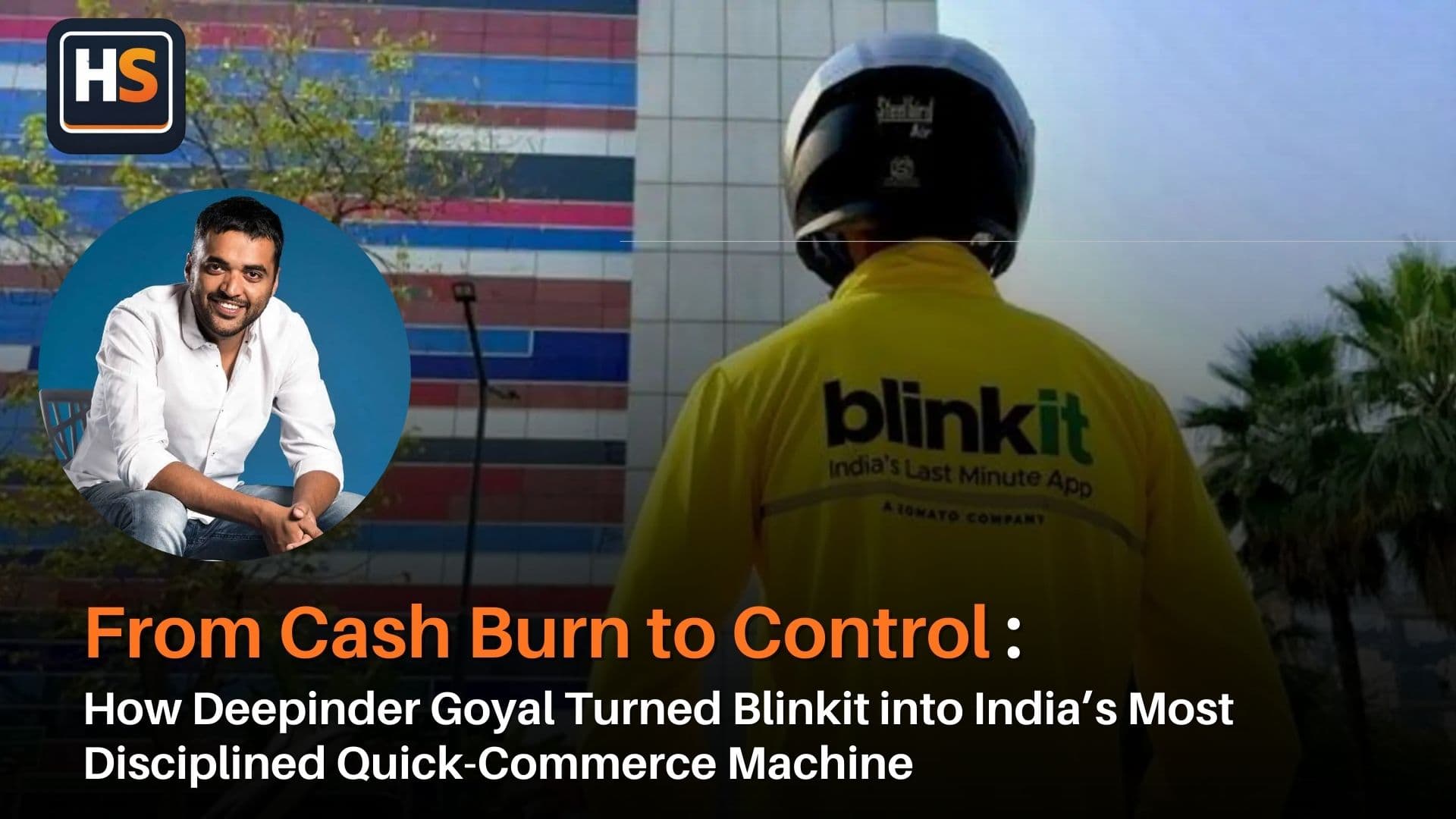
How Deepinder Goyal Turned Blinkit into India’s Most Disciplined Quick-Commerce Machine
From Cash Burn to Control
In an industry where 10-minute delivery often meant 10x losses, Blinkit’s story could have ended as another quick-commerce casualty. Instead, it became a case study in founder-led turnaround. The inflection point?
When Deepinder Goyal stopped treating Blinkit as an acquisition—and started running it like critical infrastructure.
This is the story of how operational discipline beat reckless growth.
Background: Blinkit Before the Turnaround
Founded in 2013 by Albinder Dhindsa, Blinkit (formerly Grofers) pioneered hyperlocal grocery delivery in India. But by the time quick commerce peaked:
- Dark stores were over-expanded
- Cash burn was unsustainable
- Unit economics were weak
- Speed came at the cost of efficiency
The model worked in theory—but not consistently in practice.
The Strategic Shift: Enter Deepinder Goyal
After Blinkit became part of Zomato, Deepinder Goyal assumed direct strategic control. His mindset was clear:
Quick commerce will survive only if it behaves like logistics infrastructure, not a discount-led startup.
What Deepinder Goyal Changed (And Why It Worked)
Ruthless Unit Economics First
Deepinder’s first move was unpopular—but necessary:
- Closed non-performing dark stores
- Reduced delivery radius to boost rider efficiency
- Cut low-velocity SKUs to improve inventory turns
- Focused on repeat, high-frequency essentials
Outcome: Blinkit stopped bleeding to grow and started earning to grow.
Store-Level Accountability
Borrowing from Zomato’s city-P&L model:
- Every dark store became a mini-business
- Clear metrics: pick time, dispatch SLA, contribution margin
- Daily operational reviews replaced vanity dashboards
Outcome: Predictable performance replaced chaotic scale.
Speed as a Moat, Not Discounts
Instead of competing on price wars, Blinkit doubled down on reliability and speed:
- Ultra-fast delivery became habitual, not promotional
- Consumers reordered because it worked—not because it was cheap
Outcome: Higher retention, stronger user lock-in.
Deep Zomato Ecosystem Integration
Under Deepinder, Blinkit leveraged Zomato’s strengths:
- Shared logistics learnings
- Cross-platform user acquisition
- Data-backed demand forecasting
- Brand trust transfer
Outcome: Lower CAC and faster path to profitability.
Founder-Operator Leadership
Unlike delegated CEOs, Deepinder stayed hands-on:
- Personally involved in expansion & shutdown decisions
- Strong bias toward execution over narratives
- Clear “what not to do” culture
Outcome: Organizational clarity in a volatile sector.
The Result: Blinkit Today
Blinkit is now widely viewed as:
- One of India’s most execution-efficient quick-commerce platforms
- A benchmark for dark-store economics
- Proof that q-commerce can be sustainable at scale
Not because delivery got faster—but because decisions got sharper.
Company Snapshot
| Attribute | Details |
|---|---|
| Company | Blinkit |
| Industry | Delivery, E-Commerce, Grocery, Retail |
| Headquarters | Gurgaon, Haryana, India |
| Founded | 2013 |
| Founders | Albinder Dhindsa, Rishi Arora, Saurabh Kumar |
| Strategic Leader | Deepinder Goyal |
| Funding Raised | ~$1.3B |
| Parent Company | Zomato |
Key Takeaway (The Real Lesson)
Blinkit didn’t win because quick commerce exploded.
Blinkit survived because Deepinder Goyal treated speed as infrastructure, not hype—and ran the business with surgical discipline.
This case proves one thing clearly:
In consumer tech, the second phase of leadership—not the first idea—decides who lasts.