
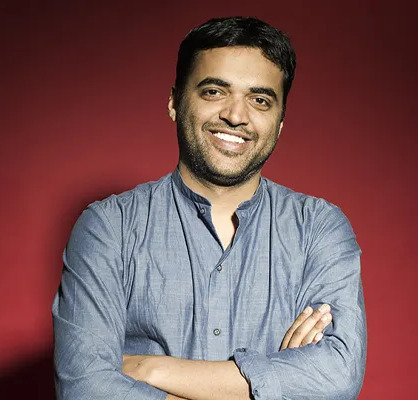

Deepinder Goyal
Deepinder Goyal — The Operator Who Built Consumer Internet at India Scale.
Deepinder Goyal is one of the most influential founder-operators in India’s consumer internet ecosystem. Best known as the founder and CEO of Zomato, his real distinction lies not in starting companies—but in scaling, fixing, and institutionalising them.
From restaurant discovery to food delivery, and now quick commerce through Blinkit, Deepinder has repeatedly demonstrated that execution discipline beats hype-led growth.
Early Life & Education
Deepinder Goyal graduated from IIT Delhi with a degree in Mathematics and Computing. Before entrepreneurship, he worked as a consultant at Bain & Company, where he developed a sharp grounding in problem-solving, data analysis, and operational efficiency—skills that later defined his leadership style.
Building Zomato: Foundation of an Operator
Deepinder founded Zomato in 2008 (originally Foodiebay) to solve a simple problem: access to restaurant information. Over time, he transformed it into a full-stack food-tech platform spanning:
- Restaurant discovery
- Food delivery
- Cloud kitchens
- Logistics infrastructure
- Merchant tools
Zomato’s journey through hyper-growth, brutal competition, layoffs, profitability cycles, and finally a public listing shaped Deepinder into a battle-tested operator, not a headline-driven founder.
Leadership Philosophy
Deepinder’s leadership is defined by a few clear principles:
- Unit economics before narratives
- Speed with accountability
- Data over opinions
- Long-term infra thinking over short-term valuation games
He is known for making unpopular but necessary decisions—cutting costs, exiting unviable experiments, and holding leaders accountable to real metrics.
Blinkit: The Second Act of Leadership
When Blinkit became part of Zomato, Deepinder didn’t treat it as a side bet. He personally stepped in to rebuild the business from first principles:
- Shut down inefficient dark stores
- Tightened delivery radiuses
- Improved store-level P&L visibility
- Focused on high-frequency grocery use cases
Under his stewardship, Blinkit evolved from a high-burn startup into one of India’s most operationally disciplined quick-commerce platforms.
This phase cemented Deepinder’s reputation as a turnaround leader, not just a founder.
Founder-Operator, Not a Figurehead
Unlike many late-stage startup CEOs, Deepinder remains deeply involved in operations:
- City-level and store-level reviews
- Expansion vs shutdown decisions
- Cultural clarity on execution standards
- Strong bias for simplicity and focus
He avoids flashy vision statements and instead emphasizes doing fewer things extremely well.
Impact on Indian Startup Ecosystem
Deepinder Goyal represents a shift in Indian entrepreneurship:
- From blitz-scaling → sustainable scaling
- From valuation-first → margin-first
- From story-driven → execution-driven leadership
His journey is frequently cited by founders, operators, and investors as a template for building large consumer businesses in India’s complex market.
Why Deepinder Goyal Matters
Deepinder’s importance goes beyond Zomato or Blinkit. He has proven that:
Indian consumer tech companies can be built with discipline, transparency, and operational rigor—without copying Silicon Valley shortcuts.
In an ecosystem often distracted by speed and fundraising headlines, Deepinder Goyal stands out as a rare operator who builds for endurance.
Beyond Zomato & Blinkit: Deepinder Goyal’s Multi-Vertical Operator Play
Deepinder Goyal’s strength as an operator is most visible not just in flagship products, but in how he has quietly built adjacent, infrastructure-grade businesses around Zomato—each solving a different layer of India’s consumer and merchant ecosystem.
District — Owning the Offline Experience
District represents Zomato’s push beyond food delivery into experiential commerce—events, dining experiences, and premium outings. Under Deepinder’s direction, District is designed as a high-intent discovery and booking layer, monetizing India’s growing appetite for curated offline experiences rather than discount-driven consumption.
The insight is simple: once trust is built online, it can be extended offline—profitably.
Hyperpure — Infrastructure for Restaurants
Hyperpure is Deepinder Goyal’s most underrated bet. It supplies restaurants with fresh produce, staples, and kitchen essentials, effectively turning Zomato into a B2B supply-chain partner, not just a marketplace.
This vertical improves restaurant quality, reliability, and margins—while giving Zomato deeper control over the food ecosystem. It reflects Deepinder’s belief that real moats are built upstream, not just at the consumer interface.
Temple — Betting on the Future
Temple is Zomato’s internal innovation and incubation arm—focused on long-term, non-obvious bets. Rather than chasing trends, Temple operates with patience, allowing small teams to explore new consumer behaviors, logistics models, and tech-led experiments without immediate revenue pressure.
It embodies Deepinder’s philosophy that enduring companies must keep experimenting—quietly and systematically.
The Common Thread
District, Hyperpure, Temple, Blinkit, and Zomato itself may look different on the surface—but they share a single operating principle:
Build infrastructure, not features. Optimize for repeat behavior, not vanity metrics.
This portfolio approach is what separates Deepinder Goyal from many consumer-tech founders. He doesn’t just build apps—he builds interlocking systems that reinforce each other.
One-Line Summary
Deepinder Goyal is not just the founder of Zomato—he is one of India’s most credible examples of how disciplined execution, operator mindset, and long-term thinking create lasting consumer internet businesses.